Chinese Hook Swords: History, Techniques, and Real Twin Hook Weapons
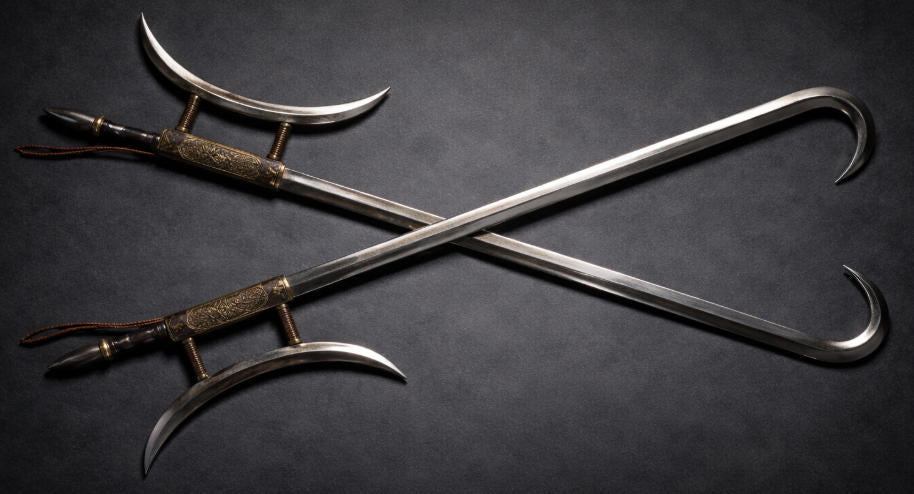
What Are Chinese Hook Swords and How Were These Twin Hook Weapons Used?
Hook swords, often referred to as Chinese twin hook weapons, are among the most intriguing and unique traditional Chinese weapons ever developed. Known for their distinctive hooked tips and complex handling techniques, these weapons have captured the attention of martial artists, historians, collectors, and enthusiasts of ancient Chinese weapons. But what exactly are hook swords, and how were they used in combat?
This deep dive explores the history of Chinese hook swords, their design evolution, practical applications, and the advanced techniques that made them formidable in martial arts and battlefield encounters.
What Are Hook Swords?
Chinese hook swords, also called shuang gou or twin hook weapons, are a class of traditional Chinese blades characterized by a long straight blade ending in a curved hook. What makes them especially unique is the secondary hook on the back of the blade, allowing users to trap, pull, and redirect an opponent’s weapon or limb.
Unlike standard single-edged swords, hook swords combine cutting edges with grappling functionality, making them versatile in skilled hands. They are best known within Northern Chinese martial arts, especially styles that emphasize weapon mastery and agile footwork.

Origins and Historical Development
The exact origin of hook swords is still debated, but most historical evidence places their development in China during the late Qing Dynasty or earlier. While not as ancient as classic broadswords or straight swords, hook swords evolved as specialized weapons used by martial artists, guards, and soldiers seeking tactical advantages in close-quarters combat.
As Chinese martial arts schools spread through various provinces, hook swords became associated with practical weapon systems and ceremonial displays alike. Their presence in martial arts manuals and traditional weapon lists reflects both real combat use and symbolic significance within martial traditions.
Unique Design and Construction
What truly sets hook swords apart from other weapons is their elaborate design:
-
Primary blade: A long, straight edge for cutting and thrusting
-
Hook tip: Curved end designed to catch and control enemy blades or limbs
-
Secondary hook: Placed near the hilt to trap weapons or limbs during combat
-
Pointed pommel: Often sharpened for striking or stabbing from the rear
This multi-functional design allowed skilled fighters to blend striking, trapping, and disarming techniques in one fluid motion. Hook swords were typically made from high-carbon steel or iron, forged to balance strength, edge retention, and flexibility—a critical combination for effective weapon performance.
How Hook Swords Were Used in Combat
In the hands of experienced warriors, hook swords were not just novelty weapons; they were effective tools for controlling the battlefield. Their design facilitated several advanced techniques:
-
Weapon trapping: Using the hook to catch and control an opponent’s blade
-
Pulling and disarming: Forcing an adversary off balance by trapping limbs or weapons
-
Cutting and thrusting: Standard offensive techniques enhanced by the hooked edges
-
Complex combinations: Seamless transitions between trapping, slashing, and striking
Martial artists who trained with hook swords developed high levels of coordination, timing, and tactical awareness. These weapons were most effective in pairs due to the ability to link hooks together for entangling enemy arms or sweeping movements.

Hook Swords in Martial Arts and Culture
While not as widespread as other Chinese weapons like the jian or dao, hook swords have a celebrated place in Chinese martial arts history. They are often showcased in traditional weapon forms, performances, and demonstrations, especially in styles that emphasize fluidity and range control.
In popular martial arts lore, hook swords are sometimes featured alongside legendary weapon systems, symbolizing skill, precision, and mastery over complex weapon mechanics. Today, they remain popular among collectors and practitioners who value their historical significance and unique combat attributes.
Training and Mastery
Learning to use hook swords effectively requires dedicated training. Because of their hooked tips and trapping capabilities, beginners may find them challenging compared to straight swords or broadswords. Training typically emphasizes:
-
Footwork and positioning: Essential for leveraging reach and angles
-
Timing and distance control: Crucial for effective trapping maneuvers
-
Paired sword coordination: Synchronizing both weapons for maximum effect
-
Safety discipline: Understanding how to train without risk of injury
Experienced martial artists often practice sequences and forms designed specifically for hook swords to build precision and muscle memory.
Why Hook Swords Still Fascinate Today
The allure of Chinese hook swords lies in their blend of form and function. They’re not only visually striking weapons but also sophisticated tools reflecting the rich history of Chinese martial arts. Whether studied for historical interest, martial arts mastery, or cultural appreciation, hook swords continue to captivate enthusiasts around the world.
Their presence in modern martial arts curricula, historical weapon collections, and martial arts media ensures that these real twin hook weapons remain alive in both practice and imagination.
-
Posted in
other
